
Roasted Coffee Preservation Techniques - Study Results (1st Round)
Disclaimer: This study is not intended to replace peer reviewed academic research. I would highly recommend more rigorous research/testing be performed by a party with more tools, time, and resources at their disposal. Bonus points if they are food scientists.
Disclaimer #2: Lucienne is a company that sells vacuum packed coffee that at some point, has been frozen. It is nice to see that this is probably a good idea based on the results of this study, but please remember that I am a random internet person who owns a business that is trying to sell you something.
At the very least, this is not AI generated slop.
Background
Many, many customers ask me how they should store their coffee after purchasing it from Lucienne. Should they put it back in the freezer? Should they just leave it out at room temperature? Should they open it? (ever???) I could never give a straight answer because if I did, I’d just be talking out of my ass.
I wanted to do this because I did not feel comfortable making coffee preservation recommendations based on anecdotal experience, and wanted real data to back it up. Surprisingly, the actual research you can find about this topic is limited, and mostly takes form in scores of random, highly opinionated comments online or questionable articles recommending special containers of some sort. You’d think that how to store coffee would be a solved problem, but the subject surprisingly sparks a lot of discourse. At least, that’s what my algorithm shows me…
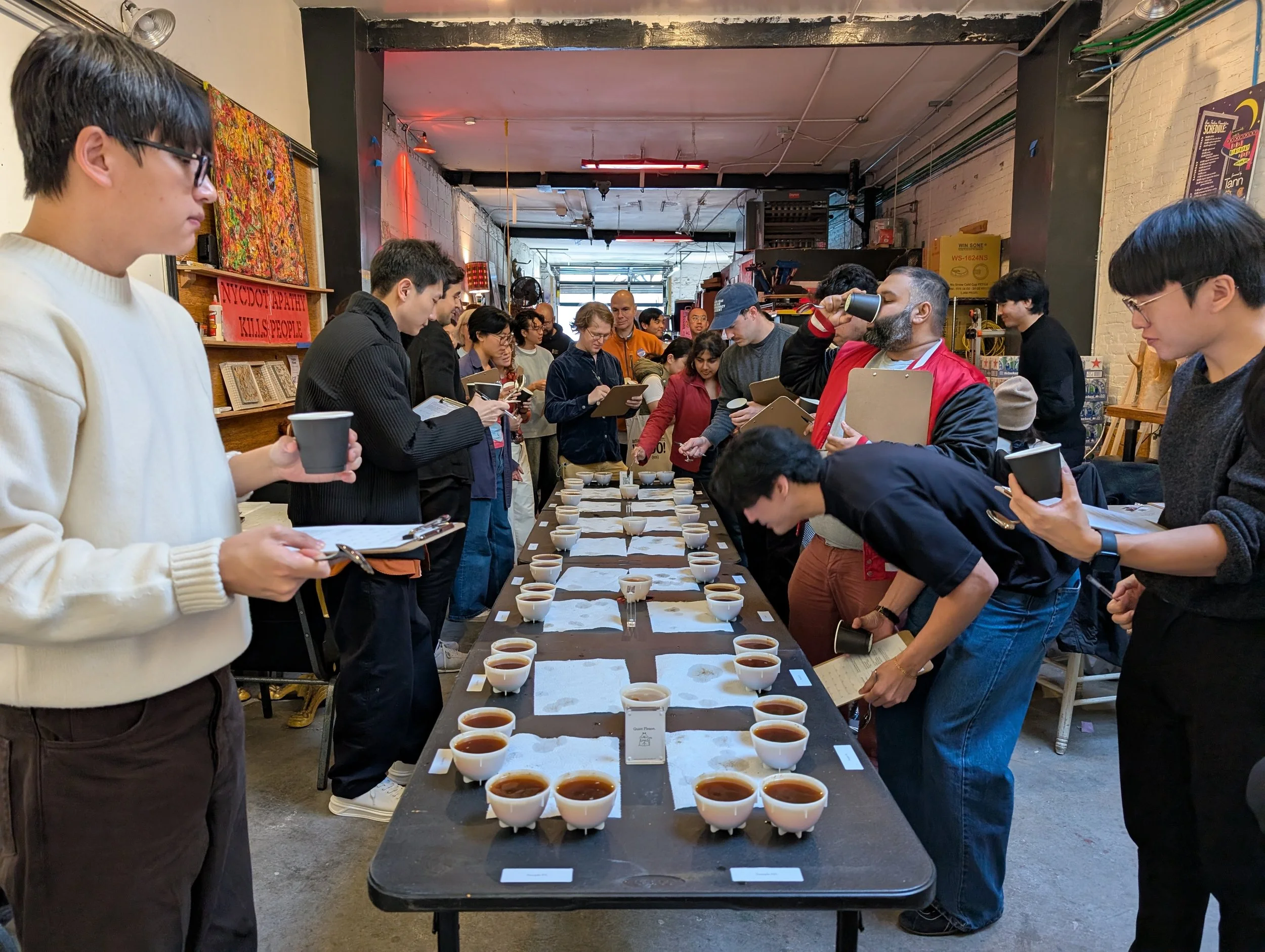
So, I designed the test, made up all the samples, stored them, and waited patiently to cup them with the great local NYC coffee community.
Sorry it took so long to publish this online. I spent a long time thinking about if the data was statistically significant or not, and finally decided that it is.
A special thanks to Principles GI Coffee House for hosting this cupping, the local NYC Coffee community for really showing up, Glitch for roasting amazing coffee, and to my husband Chris for sanity checks and editing.
I highly recommend reading through the full paper to understand the nuances of these results.
I have also included the response data in both an Excel document and in raw scans so that you may draw your own conclusions.
I would also love to hear your feedback.
Feel free to email me your thoughts.
The full research paper can be found here:
Roasted Coffee Preservation Techniques
All response data transposed to Excel (.xlsx):
Roasted Coffee Preservation Techniques Response Data
Raw response data (.zip):
Raw Response Data
TLDR:
Objective
There are countless ways to preserve roasted coffee. The purpose of this study is to identify which preservation methods are most effective in maintaining aroma, flavor, and other desirable qualities in roasted coffee over the course of multiple weeks.
Method
This was a randomized, double-blind study. Neither Lucienne, by and through its representatives and agents, nor the participants were aware of which samples represented which preservation techniques until the study was concluded.
A single batch of roasted coffee (Risaralda Milan Nitro Caturra / “G001CO” – in Lucienne nomenclature, roasted by Glitch Coffee in Tokyo, Japan) was split into 20 samples of 20 grams each 7 days post-roast. Each sample was preserved in a different way; all representing methods that the professional barista or home coffee consumer might opt for.
Results
Conclusion
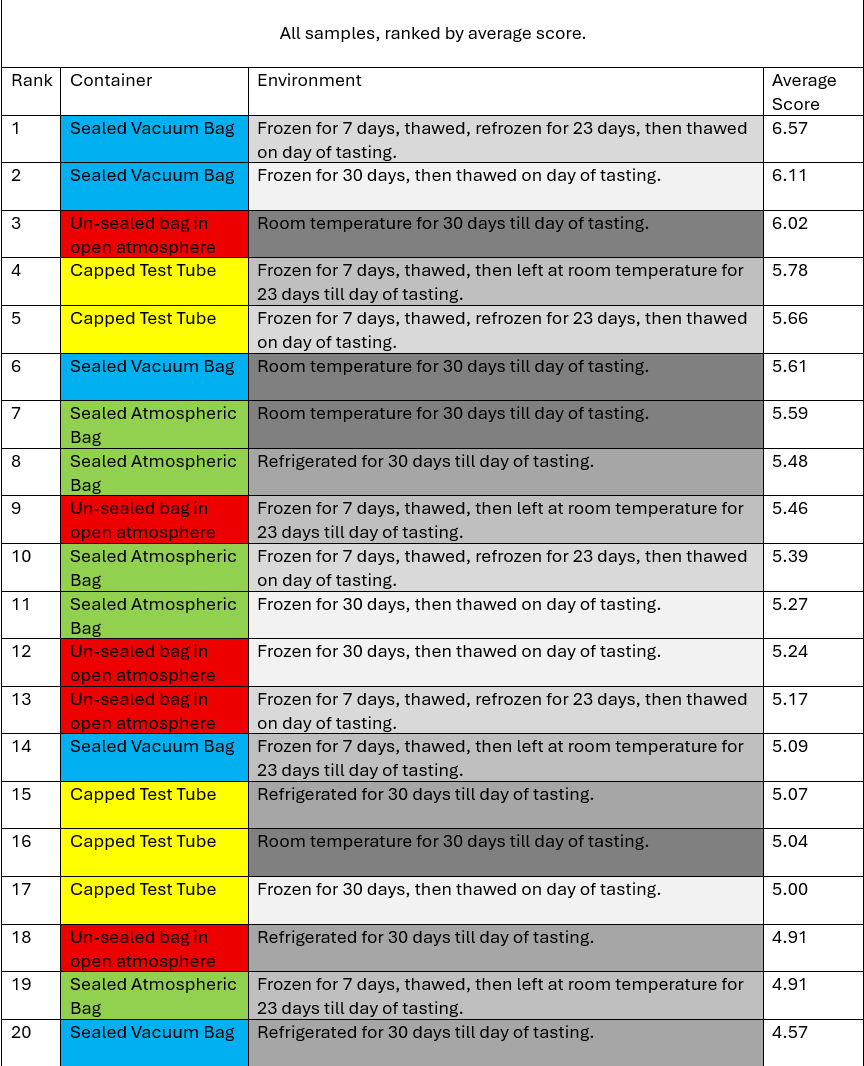
Based on the results of this test, we conclude that freezing roasted coffee has a positive effect, or at least slows down the aging of a coffee to a significant degree when compared to other environments. When combined with a stable container such as a vacuum bag, freezing seems even more effective. In fact, samples contained in vacuum bags and stored in a frozen environment scored significantly higher on average than those in other container / environment combinations.
Other container / environment combinations show more varied, less consistent results. Additionally, some containers and/or environments seem to have a negative effect, such as refrigeration.
I don’t know why tasters showed the preferences they did, or why the coffees reacted in these ways, and would recommend additional, more rigorous testing to better understand the efficacy of all container / environment combinations trialed in this study.
So how should you store your coffee? Based on this data, I recommend vacuum packing and freezing your roasted coffee until you are ready to consume it. If you are unable to do this, the next best thing would be to just leave it alone in its original packaging, and keep it at room temperature.
If you are a Lucienne customer who has received coffee already in a sealed vacuum bag, go ahead and put it in your freezer until you’re ready to consume it.
Thanks for reading.
- Josh